Energy benchmarking is more than just compliance—benchmarking data can increase visibility into performance, support budget planning, and inform upgrade prioritization for your national portfolios. Utility Benchmarking allows building owners, governments, and the public to better understand how their buildings use resources and plan for smarter and more cost-effective improvements.
Explore Required Jurisdictions
We manage monthly uploads of your energy and water data to ENERGY STAR® Portfolio Manager, perform data verification, and submit these reports to the jurisdiction website, ensuring benchmarking compliance across all required jurisdictions.
Our proven benchmarking method allows you to continuously manage your profile, keeping site data current and compliant.
As your partner
in utility expense management, we combine your energy benchmarking and
utility data management, streamlining everything into just one strategic
partner. Using our jurisdictional expertise,
we cover your benchmarking so you can confidently comply with
benchmarking regulations, gain portfolio-wide visibility, and build
actionable roadmaps. ENGIE Impact is a proud partner of the Institute for Market Transformation (IMT).
Contact us today to confidently comply with energy benchmarking regulations.
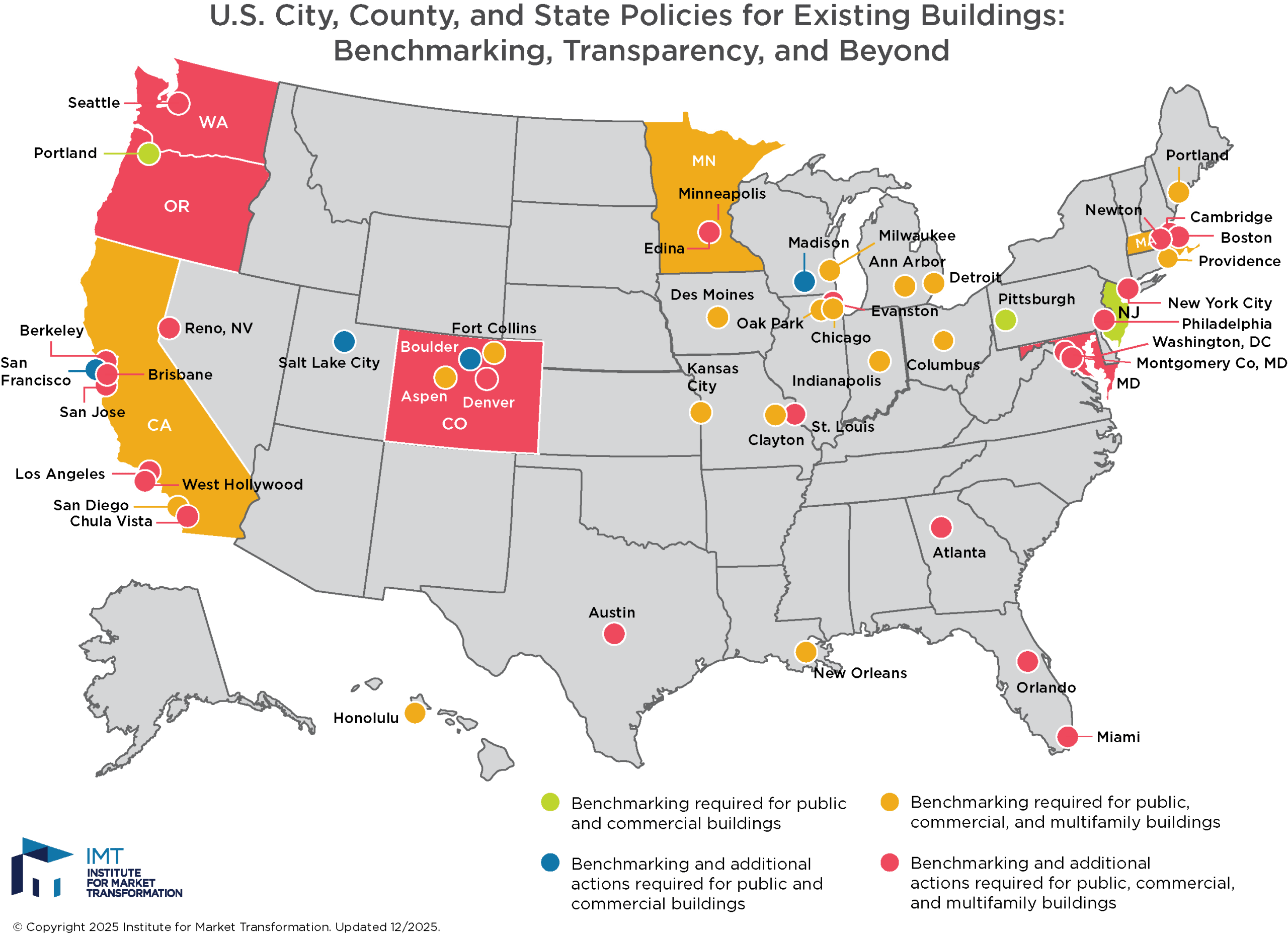
Map Source: Building Energy Benchmarking & Transparency Policies Map | IMT
*This webpage is intended for informational purposes only and should not be relied upon or interpreted as legal advice for any purpose.
Energy and Carbon Reporting (Bylaw13472 Sec 2)
Failure to comply with the by-law will render owners of buildings liable to penalties. The monetary amount is to be determined by regulation.
By-law concerning GHG emission disclosures and ratings of large buildings
The first offence is a fine of up to $1,000, the second offence is a fine of up to $2,000, and each additional offence is a fine of up to $4,000.
Reporting of Energy Consumption and Water Use (Ontario Regulation 506/18)
Allows for administrative monetary penalties for failure to report and enforcement can include orders to comply and potential public disclosure of non-compliant buildings.
Energy and Water Reporting Bylaw
Every person who contravenes any provision of this chapter, or a direction or order issued in accordance with this chapter, is guilty of an offence and on conviction is liable to a fine of no more than $100,000.
Building Energy Benchmarking Program (AB802)
The Commission has the authority to institute civil fines of up to $2,000 for non-compliance, after allowing a 30-day period to correct a violation.
Brisbane Building Efficiency Program (BBEP)
Penalties for non-compliance will be enforced as follows: (1) A fine not exceeding $100 for a first conviction; (2) A fine not exceeding $200 for a second conviction; (3) A fine not exceeding $500 for each additional conviction within 12 consecutive months.
Existing Buildings Energy and Water Benchmarking Efficiency Program (EBEWE)
Failure to comply will result in a non-compliance fee of $202. This fee is subject to a 250% late charge/collection fee after 30 days, and after 60 days will be subject to a 12% interest accrual.
Existing Buildings Energy Ordinance
Failure to submit a report for 30 days after the deadline will result in a written warning. If no report is filed within 45 days of written violation, then:
This does not apply to city-owned or municipal buildings.
Equitable Building Performance Standards (EBPS) - Benchmarking Requirements
The city may issue notices of violation for non-compliance. For each instance where an owner of a covered property fails to comply with benchmark reporting requirements, the Department may issue a citation and a fine not to exceed $1,000. If the City determines an owner has submitted an inaccurate report or if there is a discrepancy of more than 50% between third-party verified data and an owner's self-certified data, the owner will be cited and fined $1,000.
Building Energy Saving Ordinance (BESO Municipal Code 19.81)
The instances for non-compliance will result in a fine of $100 per violation per day and may increase with subsequent citations to $200 per violation per day or $500 per violation per day. If sale occurs, fines are still attributed to owner they were levied against.
Building Energy Saving Ordinance - Benchmarking Requirements
Monetary fines may be levied on a per-incident basis, dependent on the size of the property out of compliance.
Building Energy Benchmarking (Municipal Code Article 12, Division 1)
Failure to comply may be prosecuted as a misdemeanor, subject to a fine not more than $500 or imprisonment not exceeding 6 months, or both.
Energy and Water Benchmarking Building Performance Ordinance
Energy Performance for Buildings (HB 21-1286) - Benchmarking
A building owner who fails to submit a benchmarking report, waiver request, or the corresponding fee ($100/building by June 1), will be considered non-compliant and subject to civil penalties of $500 for the first violation and $2,000 for each subsequent violation.
Boulder Building Performance Ordinance
Non-compliance results in a civil penalty of $0.0025 per square foot per day, not to exceed $1,000 per day.
Building Energy and Water Benchmarking Scoring Program
Failure to report will result in a notice of need to comply 30 days within the deadline. If failure to report continues, a notice of violation will be issued with a fine of $3,000 for each year of non-compliance.
$100 first offense, $200 second offense, court appearance and court set fines thereafter.
Energize Denver - Benchmarking
$2,000 per year if benchmarking data is not submitted, data errors aren't fixed or reporting inaccurate information.
Failure to comply will result in a warning notice issued by the DOEE. Failure to provide updated data may lead to the issuance of a non-compliance penalty up to $100 per day of non-compliance.
Building Efficiency 305 Benchmarking Program
Failure to report benchmarking or reporting inaccurate benchmarking may result in a fine of $250 per day for a first-time offense or $500 per day for a repeat violation.
Building Energy and Water Efficiency Strategy (BEWES)
Properties that fail to comply will be notified by the city and publicly listed as non-compliant.
Commercial Building Energy Efficiency Ordinance
Failure to report will be noticed with a written warning (first violation); if not reported in the ensuing 30 days, a fine of $1000 is imposed. Each year of non-compliance is considered a separate violation.
Chicago Energy Benchmarking Ordinance (Ordinance Section 18-14-101.5)
A violation may be subject to a fine of up to $100 for the first violation and an additional fine up to $25 for each day the violation continues.
Fine between $20 and $750 per day. Each day of non-compliance counts as a separate offence.
Building Energy and Water Use Benchmarking Ordinance
$100 per month of non-compliance 20 days after written notice of violation.
Thriving Buildings Benchmarking (Bill 185-21)
Penalties for non-compliance do not take effect until January 1st, 2026.
Energy and Water Benchmarking Ordinance (Ordinance 15.779)
The City of Des Moines will not be assessing any penalties for properties who are not in compliance with this ordinance.
Failure to comply with the benchmarking requirement may result in fines between $1,000 and $3,000. Penalties will be waived in the first year a property is required to comply.
Energy Benchmarking (Section 6-217)
The fines for non-compliance are $20 per day.
Benchmarking and Reporting [COMAR 26.28.02]
Up to $2,500 per violation under Maryland Environment Article §2-610. Each day of non-compliance may count as a separate violation, increasing liability. Not more than $50,000 total for any single administrative hearing.
Building Energy Use Benchmarking (Bill 35-15)
Failure to report is considered a Class A Violation.
Class A civil violations are penalized with a $500 fine for the initial offense, and additional $750 fines for repeat offenses.
Large Building Energy Reporting (225 CMR 27.04)
If a distribution company or municipal utility fails to provide energy usage data for one or more covered buildings within 90 days of the issuance of a written notification, the Department may issue a fine of up to $150 per covered building per day of non-compliance. If a building owner fails to provide energy usage information within 30 days from the issuance of a written notification, the Department may issue a fine of up to $150 per day of non-compliance. If a lessee that comprises greater than 5% of the total gross floor area of a covered building fails to respond within 30 days to a written request for energy usage information by a building owner, the Department may issue a fine of up to $150 per day of non-compliance.
Building Energy Use Disclosure Ordinance (BEUDO)
First violations will result in a written warning, and any subsequent violations carry a fine of up to $300 per day.
$300 per violation.
Building Emissions Reduction and Disclosure (BERDO) Boston
Building Emissions Reduction and Disclosure Ordinance (BERDO)
Failure to report benchmarking requirements will result in a fine of $50 for the first offense, $150 for the second offense, $300 for the third offense, as enforced by building inspectors.
Building Emissions Reduction and Disclosure Ordinance (BERDO) Newton – Benchmark
Any violation of this ordinance shall be punishable by a fine of $300 per day for each day the violation continues.
Energy & Water Benchmarking Ordinance
Energy Waste Reduction Benchmarking Ordinance
Fines up to $10,000 per violation, with each day of non-compliance counting as a separate violation.
Building Energy Use Benchmarking Program (HF 2269)
$1,000, may adjust with inflation.
Energy Benchmarking, Benchmarking and Enforcement Timeline
Information on penalties for non-compliance differs based on which source it comes from. Below are the penalties outlined in the municipal code.
Failure to benchmark shall result in a warning notice. Failure to comply within 45 days of written notice may be considered good cause for the denial, suspension, revocation, or refusal to issue a rental license, certificate of commercial building registration, or business license.
Building owners will receive a written warning indicating why the building is noncompliant. The building owner has 45 business days to meet compliance, or the city has cause for the denial, suspension, revocation, or refusal to issue any applicable business license held by the property owner or person.
Building Energy Awareness Ordinance
Any violations of this ordinance shall result in a fine of not more than $1,000 or be punished by imprisonment in jail for no more than 90 days, or a punishment of both fine and imprisonment. Each day of violation counts as a separate offense.
Building Energy Awareness Ordinance
Failure to comply shall result in a written warning. If benchmarking is not reported within 60 days of the issuance of written warning, it will be considered an offense and punishable via fine of not less than $50 but not more than $200. Each day of violation is considered a separate offense. No cumulative fine should exceed $1000 annually.
Kansas City Energy Empowerment Ordinance
In the case of failure to report benchmarking, a written notice will be issued. If benchmarking information is not reported within 60 days of the written notice it will be a violation and will result in a fine, no less than $50 but not more than $500. For continued violation, each additional day will be considered a separate offense. Fines would not exceed $2,000 annually.
Energy and Water Benchmarking Efficiency Ordinance (Section 14.30.014)
Failure to report or submitting incomplete or inaccurate information will result in a written notice. Failure to correct within 30 days of written notice may result in notice of violation and penalty of up to $100. Failure to correct within 30 days of first violation may result in a second violation and penalty of $250. Failure to correct within 30 days of second violation may result in a fine of up to $500.
Compliance with benchmarking is considered prerequisite for participation in any of the NJ Board of Public Utility programs, as well as utility energy efficiency programs.
Building Health and Performance Law
Deadline Multifamily: The initial benchmarking shall occur no later than the required completion date as set by the Town of Bedford after registration of the Residential Rental Property, or 3 years after this Chapter is re-enacted, whichever comes first.
Maximum fee of $5,000, imprisonment not exceeding 6 months, or both fee and imprisonment. Each day a violation continues shall count as a separate offense.
The NYC Benchmarking Law (LL84)
Failure to comply with benchmarking may result in a Notice of Violation by the Department; failure to submit by the June 30th deadline results in a penalty of $500. Continued failure to report by the next quarterly deadline may result in additional violations with penalties of $500 per violation, up to $2,000 a year.
If a correction of a violation occurs within 60 days of notice, no civil penalty shall be imposed.
Energy & Water Benchmarking and Transparency Ordinance (Ordinance 0452-2020)
If benchmarking is not reported within 30 days after the deadline, a written notice is issued. 60 days after a written notice, the owner will be subject to fees and penalties of up to $1,000 per day of non-compliance.
Energy Performance Standards (HB3409) - Benchmarking
$5,000 plus continuing violation which may not exceed a daily amount of $1/yr/sf ft.
Commercial Building Energy Reporting (Ordinance No. 187095)
Failure to report benchmarking requirements or reporting inaccurate information shall be subject to a written notice on first violation, and a civil penalty of up to $500 per 90-day period during which the violation continues.
Building Energy Benchmarking (Bill No. 120428-A)
Pittsburgh Building Benchmarking Ordinance
Covered buildings that do not comply with benchmarking requirements will be publicly listed as being non-compliant on the city website.
Building Energy Reporting Ordinance
First violation - written warning
Second and subsequent violation:
Energy Conservation and Disclosure Ordinance (ECAD)
Non-compliance carries a fine up to $500. Acting with criminal negligence carries a fine up to $2,000.
Elevate Buildings (Municode CHAPTER 18.94)
The Director may issue up to 3 written notices of noncompliance to the owner, allowing owner to cure such noncompliance within 90 days after each notice of violation. After the third written notice of violation, the Director may impose a fine of up to $500.00 per violation thereafter not exceeding a total of $1,000 annually.
The building owner will be assessed the maximum penalty of $5000 plus a daily amount equal to $1.00 per square foot of gross floor area per year not to exceed a value greater than eighteen months of accrued penalty. Penalties are assessed for each compliance period.
For applicants that submit a noncompliance mitigation plan and who submit documentation demonstrating completion, daily penalties will be assessed from the scheduled compliance date to the date of approval of compliance or conditional compliance. The penalty will be assessed at an amount not to exceed 30% of $5000 plus a daily amount equal to $0.20 per square foot of gross floor area per year.
Energy Benchmarking Law (Chapter 22.920)
Noncompliance fines for reporting year will be streamlined into a single Notice of Violation issued 90 days after the June 1st reporting deadline in place of quarterly accruing fines. Fines for properties between 20,000 and 50,000 sq ft will be $2,000; Fines for properties greater than 50,000 sq ft will be $4,000.
Building Energy Savings Program
$1,000 per 90 days of non-compliance.
Efficient Buildings Benchmarking Program
Talk to our experts about simplifying your benchmarking compliance and reporting.



Utility benchmarking is the practice of measuring how much energy and water a building consumes and comparing that against other, similar buildings. Utility benchmarking and transparency allows organizations to see how their buildings use energy and water. With this knowledge, they can make improvements to their buildings, comply with local laws and avoid fines, save money and cut waste, and support the local economy. Most available savings can be achieved with only low- or no-cost changes. Contact our experts to learn more.
Energy benchmarking noncompliance can result in monetary fines and reputational damages. The severity of noncompliance penalties vary by location—see the map for details.
In addition to remaining compliant with energy benchmarking requirements, benchmarking can help your organization identify inefficiencies, prioritize energy-saving investments, reduce operational costs, and track performance improvements over time. Energy benchmarking represents an opportunity to establish a data-driven baseline for gaining portfolio-wide visibility and building actionable roadmaps.
While building owners may complete energy benchmarking themselves, ENERGY STAR® is the golden standard for this service. And with ENGIE Impact as an expert partner, you can confidently comply with energy benchmarking regulations. Schedule a meeting with one of our experts to get started.