Building Performance Standards (BPS) compliance begins with data. By leveraging your utility data for ENERGY STAR® benchmarking and other reporting and compliance needs, you can simplify your Utility Expense Management and build a roadmap to more efficient buildings through BPS audits.
BPS is more than simply complying with regulations and avoiding fines—it's a long-term path to more efficient operations, improved building value, and maximized energy performance. By optimizing your facilities to improve efficiency, you can save on energy costs while reducing your carbon footprint.
Explore Building Performance Standards
By partnering with your internal stakeholders to conduct site-level audits where needed, we deliver detailed compliance assessments and create actionable roadmaps to guide your path to BPS compliance. Our powerhouse team of Certified Energy Managers developed a proprietary process from their world-class expertise.
As your partner in BPS compliance, we go granular: We help you with the data. As a 19-time ENERGY STAR® Partner of the Year, we have proven benchmarking and audit experience and provide scalable, on-the-ground support. Equipped with our deep regulatory knowledge and access to the best resources, you can have the tools your organization needs to turn BPS compliance into competitive advantage. ENGIE Impact is a proud partner of the Institute for Market Transformation (IMT).
Get in touch with our experts to start building your BPS roadmap.
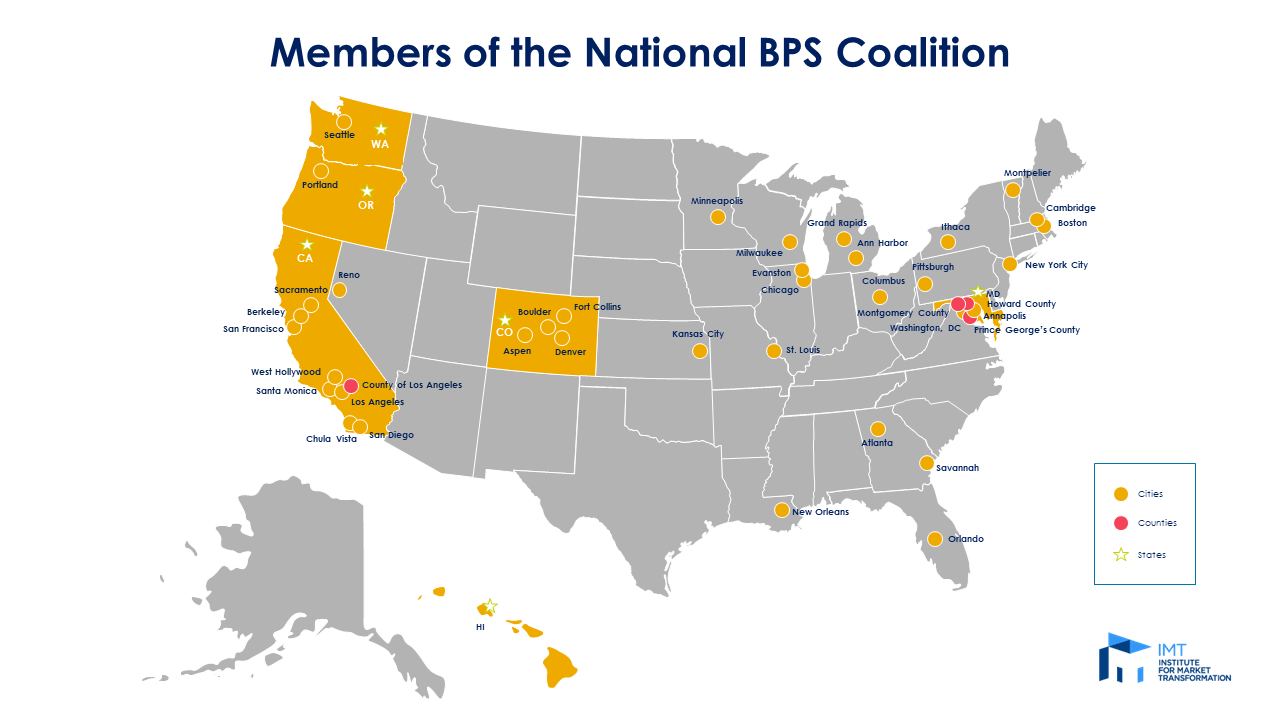
Map Source: Institute for Market Transformation
*This webpage is intended for informational purposes only and should not be relied upon or interpreted as legal advice for any purpose.
Greenhouse Gas and Energy Limits By-law 13472
Commercial: 50,000 sq ft or greater
SB 48: Building Energy Savings Act, establishes that the Energy Commission, in consultation with the State Air Resources Board, Public Utilities Commission, and Department of Housing and Community Development, develop a strategy, on or before July 1, 2026, to track and manage the energy usage and emissions of greenhouse gases of covered buildings to achieve the states goals, targets, and standards related to energy usage and emissions of greenhouse gases. The bill would require the Energy Commission to submit the strategy and recommendations for further legislative action that would help achieve certain objectives to the Legislature on or before August 1, 2026.
Brisbane Building Efficiency Program (BBEP)
Existing Buildings Energy and Water Efficiency (EBEWE) Program
Energy and Water Building Performance Ordinance (BPO)
Buildings 20,000 – 49,999 sqft have a due date 1 year after the dates stated above for the indicated APN (Assessor’s Parcel Number).
Building Emissions Saving Ordinance (BESO)
Building Energy Saving Ordinance (BESO)
Existing Building Energy Ordinance
Building Performance Colorado (BPC) Program
Energize Denver Building Performance Standards (BPS)
Building Performance Ordinance (BPO) Program
Retro-commissioning (RCx) implementation due 2 years after dates listed above. Lighting upgrades only need to happen once.
Building Performance Standards (BPS)
Building Energy Performance Standards (BEPS)
Building Efficiency 305 Benchmarking Program
Building Energy and Water Efficiency Strategy (BEWES)
Commercial Building Energy Efficiency Ordinance (CBEEO)
Building Performance Standards (BPS)
Building Energy Performance Standards (BEPS)
Building Energy Performance Standards (BEPS)
Building Emissions Reduction and Disclosure Ordinance (BERDO 2.0)
Building Emissions Reduction and Disclosure Ordinance (BERDO)
Building Energy Use Disclosure Ordinance (BEUDO)
Buildings Emission Reduction and Disclosure Ordinance (BERDO)
Business/Commercial Buildings & Energy
Building Energy Performance Standards (BEPS)
Building Energy Performance Standards (BEPS)
Buildings Performance Standard (BPS)
Tier 1: Commercial buildings ≥35,000 sqft; Tier 2: Multifamily, hospital, school, dormitory, or university buildings ≥35,000 sq ft; or commercial buildings 20,000 - 35,000 sqft.
Bureau of Planning and Sustainability (BPS)
Building Energy Performance Program
Energy Conservation Audit and Disclosure Ordinance (ECAD)
Clean Building Performance Standards (CBPS)
Building Emissions Performance Standard (BEPS)
Buildings Energy Savings Program (BESP)



Talk to our experts about creating your BPS roadmap.
Building Performance Standards (BPS) are enforceable policies that require buildings to measure, improve, and report energy, water, and emissions performance over time. Cities, counties, and states use BPS to reduce climate risk, control rising energy costs, and manage growing energy demand.
BPS build on benchmarking laws introduced over the past decade—but they go further by requiring action, not just reporting. If your building is covered, you’ll need to demonstrate ongoing performance improvements and submit verified data to your local jurisdiction.
Most U.S. states have comprehensive policies in place for newly constructed buildings, but existing buildings also require improvements. Building Performance Standards improve the energy performance of existing buildings, which present the greatest opportunity for climate impact and operational upgrades on the quickest timeline.
Building Performance Standards are outcome-based policies, whereas traditional building codes are more prescriptive and apply to new buildings. BPS complement traditional building energy code approaches, but they work differently.
All BPS policies share these key elements:
Most BPS policies are locally tailored, flexible, and are built for long-term certainty. Visit IMT for more information.
Depending on your location, BPS laws typically require building owners to complete one or more of the following:
Common upgrades to existing buildings include energy efficiency retrofits, HVAC modernization, building envelope improvements, electrification (heat pumps, induction, etc.), and on-site renewables. These improvements help meet compliance requirements while reducing building costs.